
SEICOR
Ship Emission Inspection with Calibration-free Optical Remote Sensing
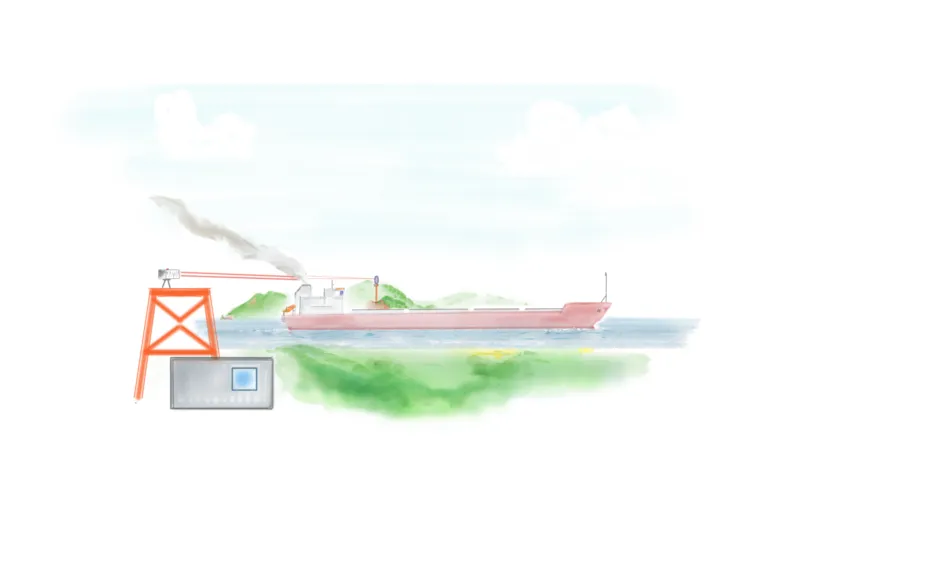
Active infrared absorption measurements developed by our group form a key part of the SEICOR system, which aims to quantify ship emissions over kilometer-scale distances.
Objectives
Laser light of known wavelength is sent through the atmosphere and analyzed after reflection, providing path-integrated CO₂ concentrations. Reliable CO₂ detection is essential because CO₂ serves as the indicator for deriving emission factors of NOₓ and SO₂ from passing vessels.
The infrared absorption set-up has been optimized to improve the stability and sensitivity of CO₂ measurements. The laser is driven by a Zurich Instruments lock-in amplifier, which also performs synchronized demodulation of the detector signal. This configuration lowers noise and stabilizes the phase behavior, enabling a more consistent interpretation of CO₂ absorption features. Laboratory tests show that temperature variations introduce a clear diurnal pattern in the signal baseline. Current work focuses on using the signal-to-noise ratio to detect plume-like features along the light path under Gaussian plume assumptions, while CO₂ concentrations can be refined by combining the IR measurements with NO₂ data from the partner's DOAS system.
To approximate atmospheric path lengths of several kilometers, a high-concentration CO₂ source has recently been added to the set-up. This enables controlled testing under conditions representative of open-path measurements across wide rivers. The extended configuration is now used to assess plume detection performance under realistic concentration ranges and to identify stable measurement settings. Initial tests already show clear responses during ship-like plume events, with CO₂ enhancements of roughly 10–300 ppm depending on emission strength and dilution during transport.
Responsible
Dr. Cheng Ye
Partners:
Airyx GmbH
HORIBA Europa
Universität Bremen