
- Catalytic Enantioselective [6π] Photocyclization Reactions by Chromophore Activation with a Chiral Lewis Acid. J. Am. Chem. Soc. 147 (50), 2025, 46525-46534 mehr…
- Intramolecular ortho Photocycloaddition of 4-Substituted 7-(4′-Alkenyloxy)-1-indanones and Ensuing Reaction Cascades. J. Org. Chem. 90, 2025, 4099-4107 mehr…
- Enantioselective Intramolecular ortho Photocycloaddition Reactions of 2‐Acetonaphthones. Angew. Chem. Int. Ed. 63, 2024, e202318126 mehr…
- Photochemical Isomerization of Cyclohept-1-ene-1-carbaldehyde: Strain-Release Cycloadditions and Ene Reactions. J. Org. Chem., 2023, 12844-12852 mehr…
- Enantiodivergent Photochemical Rearrangements Due to Different Coordination Modes at an Oxazaborolidine Lewis Acid Catalyst. ACS Catal. 13, 2023, 5896-5905 mehr…
- The Awakening of a Sleeping Beauty: The ortho Photocycloaddition in the Total Synthesis of Protoilludane- and Prezizaene-Type Sesquiterpenes. Synlett 34, 2023, 1343-1355 mehr…
- Photochemical Ring Contraction of 5,5-Dialkylcyclopent-2-enones and in situ Trapping by Primary Amines. J. Org. Chem. 88, 2023, 6294-6303 mehr…
- Bicyclo[2.1.1]hexanes by Visible Light-Driven Intramolecular Crossed [2+2] Photocycloadditions. Org. Lett. 24, 2022, 8821-8825 mehr…
- Photoinduced B–Cl Bond Fission in Aldehyde-BCl3 Complexes as a Mechanistic Scenario for C–H Bond Activation. J. Am. Chem. Soc. 144, 2022, 18927-18937 mehr…
- Chiral Lewis acid catalysis in a visible light-triggered cycloaddition/rearrangement cascade. Chem. Sci. 13, 2022, 11856-11862 mehr…
- Diels–Alder Reaction of Photochemically Generated (E)-Cyclohept-2-enones: Diene Scope, Reaction Pathway, and Synthetic Application. J. Org. Chem. 87, 2022, 4838-4851 mehr…
- Enantioselective Crossed Intramolecular [2+2] Photocycloaddition Reactions Mediated by a Chiral Chelating Lewis Acid. Chem. Sci. 13, 2022, 2378-2384 mehr…
Chromophore Activation by Lewis Acid Coordination
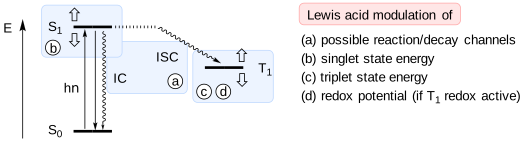
Introduction. Recent interest in Lewis acid catalyzed photochemical reactions has been triggered by the desire to devise enantioselective methods for the construction of typical photochemical reaction products, e.g. cyclobutanes. The existing methods can be crudely classified into four categories based on their mode of action:
(a) The Lewis acid changes the dynamic properties of the excited state(s) by opening a reaction channel that is not accessible in the absence of the Lewis acid (IC = internal conversion, ISC = intersystem crossing).
(b) The Lewis acid alters the energy of the singlet excited state(s), which is typically detected by a bathochromic (or hypsochromic) shift in the UV/Vis spectrum (S0 = electronic ground state, S1 = first excited singlet state).
(c) The Lewis acid modulates the energy of the triplet excited state(s), which is detectable in the phosphorescence spectrum or by quenching studies with a triplet sensitizer the triplet state energy of which is known (T1 = lowest triplet state).
(d) By changing the energy of the excited state, the Lewis acid invariably leads to a change in the redox potential of the excited state making it a stronger oxidant or reductant. If the triplet state is populated, it will be the redox properties of T1 which are altered.
Summary of the Project. The project aims to discover and to identify salient features of complexes between typical chromophores and Lewis acids. If the Lewis acid acts catalytically, its proximity to the substrate in a 1:1 complex invites the use of chiral Lewis acids for enantioselective C−C bond formation. During this funding period, the project will address three major objectives. The first objective revolves around the photochemical activation of bonds within assemblies of boron-based Lewis acids and Lewis-basic nitrogen compounds, most notably pyridine. There are indications that Lewis base coordination to a boron center facilitates a homolytic bond cleavage. Vice versa, a Lewis acid might unlock new reactivity patterns of pyridine and related nitrogen heterocycles. The second goal addresses enantioselective photochemical reactions catalyzed by chiral oxazaborolidine Lewis acids. A new binding motif has been discovered which holds promise for an application of the Lewis acids to yet inaccessible substrates. Reaction types include photocyclizations, rearrangements, hydrogen atom reactions and [2+2] photocycloadditions. The final objective aims at a dearomatization of benzene derivatives by photocycloaddition at the arene core. Lewis acids are proposed to lower the intrinsically high barrier of this process paving the way to visible light-mediated reactions. The main focus will be on inter- and intramolecular ortho photocycloadditions with the potential to induce chirality by the use of a chiral Lewis acid.
Recent Publications
Earlier Key Publications
- Activation of 2‐Cyclohexenone by BF3 Coordination: Mechanistic Insights from Theory and Experiment. Angew. Chem. Int. Ed. 60, 2021, 10155-10163 mehr…
- Chiral 1,3,2-Oxazaborolidine Catalysts for Enantioselective Photochemical Reactions. Acc. Chem. Res. 53, 2020, 1933-1943 mehr…
- Lewis Acid Catalyzed Enantioselective Photochemical Rearrangements on the Singlet Potential Energy Surface. J. Am. Chem. Soc. 141, 2019, 20053-20057 mehr…
- Reversal of reaction type selectivity by Lewis acid coordination: the ortho photocycloaddition of 1- and 2-naphthaldehyde. Chem. Sci. 10, 2019, 8566-8570 mehr…
- Intramolecular [2+2] Photocycloaddition of Cyclic Enones: Selectivity Control by Lewis Acids and Mechanistic Implications. Chem. Eur. J. 25, 2019, 8135–8148 mehr…
Application
If you are interested in joining our team as a PhD student or as a post-doc we would be happy to hear from you. Applications (single .pdf document) should typically include a letter of motivation, CV, an academic transcript of records, and contact information of two references, preferable in English. Prospective PhD students should apply exclusively to apply-crc325@ur.de. Candidates for a post-doctoral position should send their application letters to thorsten.bach@ch.tum.de.