
Combined Concentration Methods
Concentration methods such as separation and filtration techniques are critical in analytical laboratories to achieve concentrations of target compounds high enough to detect using various instruments. Further, it can be an important step in sample preparation, useful for the removal of matrix compounds that could otherwise interfere with analysis. There are several considerations for separation: (1) it should be selective for the target compound, (2) the entire volume of the sample, which can be very large, must be efficiently processed, and (3) the recovery of the target should be high. To do so, there are several techniques and methodologies that the Group of Bioanalytics and Microanalytical Systems employ.
Technologies and Methods
Crossflow Ultrafiltration (CUF):
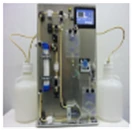
Cross-flow ultrafiltration is a membrane-based separation technique that allows for the processing of large liquid volumes and the enrichment of target compounds. In this system, the liquid sample is continuously pumped in a closed loop and flows tangentially across the surface of a semipermeable membrane. This “cross-flow” configuration minimizes membrane fouling and ensures stable filtration performance over extended operation times.
Molecules are separated according to their size: small molecules and solvents pass through the membrane as permeate, while larger compounds are retained in the sample loop. As water or buffer continuously circulates, compounds above the membrane’s pore size gradually accumulate in the retentate. After elution of this retained fraction, the target compound is obtained in a highly concentrated form. This technique has been successfully applied for virus concentration from water, achieving up to 10⁴-fold enrichment and high recovery rates, demonstrating its effectiveness for rapid and scalable detection of viruses in drinking and surface water samples (Pei et al., 2012; Kunze et al., 2015).
Literature:
Pei, L., Rieger, M., Lengger, S., Ott, S., Zawadsky, C., Hartmann, N. M., Selinka, H. C., Tiehm, A., Niessner, R., & Seidel, M. (2012). Combination
of crossflow ultrafiltration, monolithic affinity filtration, and quantitative reverse transcriptase PCR for rapid concentration and quantification of model viruses in water. Environmental Science & Technology, 2012, 46, 10073–10080.
https://doi.org/10.1021/es302304t
A. Kunze, L. Pei, D. Elsässer, R. Niessner, M. Seidel, High performance concentration method for viruses in drinking water, J. Virol. Meth. 222, 2015, 132–137. https://doi.org/10.1016/j.jviromet.2015.06.007
Monolithic Adsorption Filtration (MAF):
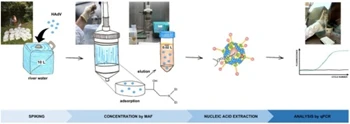
Monolithic adsorption filtration (MAF) is a concentration technique to filter and enrich biological and organic analytes from large aqueous sample volumes. The method utilizes monolithic epoxy-based polymer filters with a continuous, highly porous structure composed of macropores. The surface of the monolith can be functionalized with chemically reactive groups, so that compounds of interest are adsorbed onto the surface based on their chemical affinity or hydrophobic interactions, while unbound matrix components pass through. Pore size, shrinkage, and porosity can be defined by a mixture of organic solvents as porogen and moderate temperatures (Peskoller et al., 2009). The pores of the monolith enable convective flow and low backpressure, allowing rapid filtration for complex matrices. After adsorption, the retained analytes can be eluted in a small volume of a defined elution buffer, resulting in a concentrated and purified solution suitable for downstream bioanalytical methods like flow cytometry, immunoassays, haRPA, qPCR or metagenome analysis. MAFs with different sizes were meanwhile successfully applied for drinking water (Kunze et al., 2015), river water (Wunderlich et al., 2016), sewage water (Hjelmsø, 2019) and urine samples (Neumair et al., 2023). The applicability was shown for concentration of bacteria (Göpfert et al., 2020) and viruses (Hess et al., 2021) from large-volume water samples as innovative adsorption elution method, and for extracellular vesicles in urine (Neumair et al., 2023) and Staphyloccus aureus (Ott et al., 2012) by monolithic immunofiltration.
Literature:
Göpfert, L.; Klüpfel, J.; Heinritz, C.; Elsner, M.; Seidel, M. Macroporous epoxy-based monoliths for rapid quantification of Pseudomonas aeruginosa by adsorption elution method optimized for qPCR. Analytical and Bioanalytical Chemistry, 2020, 412, 8185–8195. doi.org/10.1007/s00216-020-02956-3.
Hess, S., Niessner, R., & Seidel, M. Quantitative detection of human adenovirus from river water by monolithic adsorption filtration and quantitative PCR. Journal of Virological Methods, 2021, 292, 114128. doi.org/10.1016/j.jviromet.2021.114128.
Hjelmsø, M.H.; Hellmér, M.; Fernandez-Cassi, X.; Timoneda, N; Lukjancenko, O.; Seidel, M.; Elsässer, D.; Aarestrup, F.M.; Löfström, C.; Bofill-Mas, S.; Abril, J.A.; Girones, R.; Schultz, A.C. Evaluation of Methods for the Concentration and Extraction of viruses from Sewage in the Context of Metagenomic Sequencing. PLOS ONE, 2017, 1, e0170199. doi.org/10.1371/journal.pone.0170199.
Neumair, J.; D’Ercole; De March, M.; Elsner, M.; Seidel, M.; De Marco, A. Macroporous epoxy-based monoliths functionalized with anti-CD63 nanobodies for effective isolation of extracellular vesicles in urine. International Journal of Molecular Sciences, 2023, 24, 6131,
https://doi.org/10.3390/ijms24076131.
Ott, S.; Niessner, R.; Seidel, M., Preparation of epoxy-based macroporous monolithic columns for the efficient immunofiltration of Staphylococcus aureus. Journal of Separation Science, 2011, 34, 2181-2192. doi.org/10.1002/jssc.201100208 .
Pei, L., Rieger, M., Lengger, S., Ott, S., Zawadsky, C., Hartmann, N. M., Selinka, H. C., Tiehm, A., Niessner, R., & Seidel, M. (2012). Combination of crossflow ultrafiltration, monolithic affinity filtration, and quantitative reverse transcriptase PCR for rapid concentration and quantification of model viruses in water. Environmental Science & Technology, 2012, 46, 10073–10080.
https://doi.org/10.1021/es302304t
Peskoller, C.; Niessner, R.; Seidel, M., Development of an epoxy-based monolith used for the affinity capturing of Escherichia coli bacteria. Journal of Chromatography A, 2009, 1216, 3794-3801. https://www.sciencedirect.com/science/article/pii/S0021967309002945.